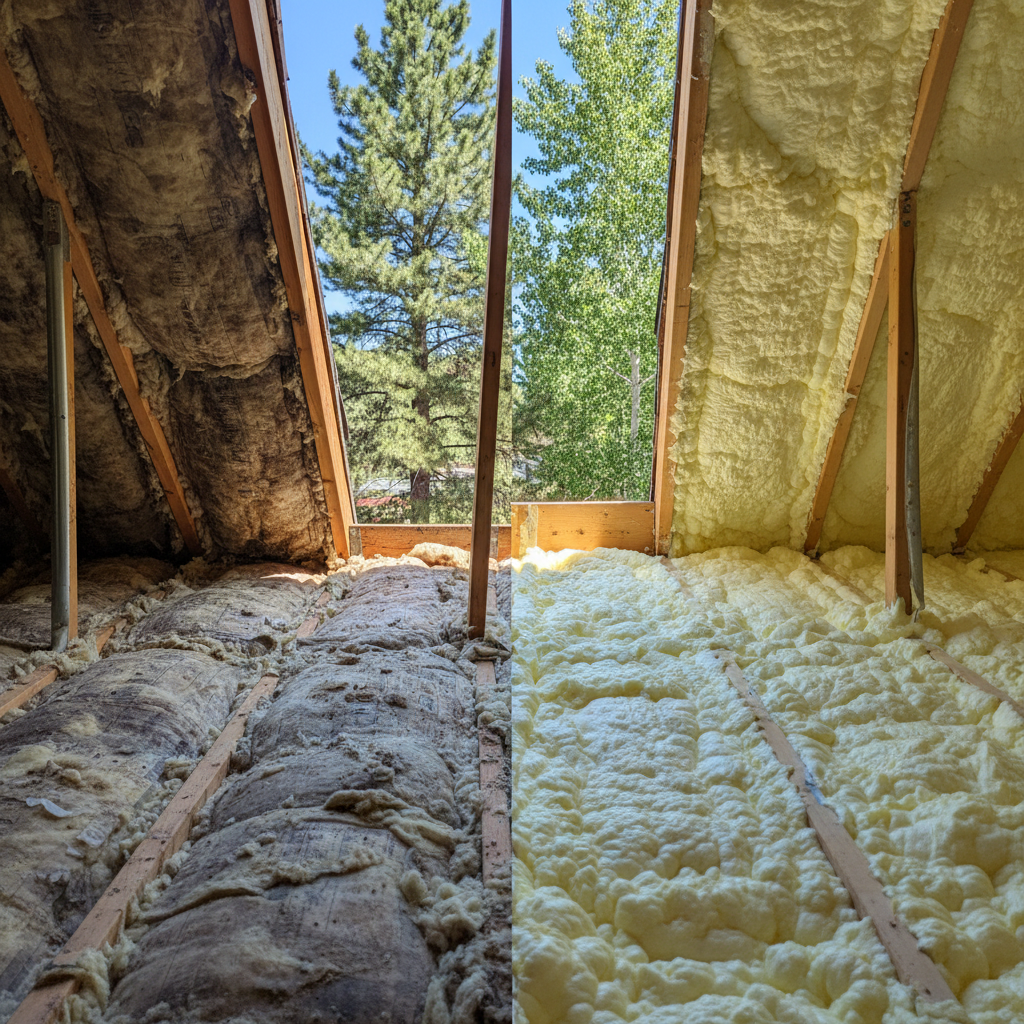
Alright, let's talk open cell spray foam. If you're looking into it for your home here in Flagstaff, you've probably heard a few terms thrown around. Two big ones that pop up are 'flash and batt' and 'full cavity' applications. What's the real difference between them? And more importantly, which one makes sense for your place?
Flash and Batt: The Hybrid Approach
So, 'flash and batt' is pretty much what it sounds like: a flash of spray foam, usually an inch or two thick, goes directly onto the sheathing or foundation wall. Then, traditional batt insulation (fiberglass or mineral wool) gets installed right over it to fill the rest of the cavity. It's a hybrid system, you see.
Why would someone choose this route? Well, for starters, it's often a bit cheaper upfront than a full cavity spray foam job. You're using less spray foam, which is the more expensive material, and filling the rest with a cheaper product. The idea is that this thin layer of spray foam creates an air seal, stopping air leakage, and the batt insulation provides the bulk of the R-value. Simple enough, right?
Durability-wise, the spray foam itself holds up well. But the batt insulation can still be vulnerable to moisture if that initial air seal isn't perfect, or if you've got other moisture issues lurking around. It's just not as strong as a full spray foam application when it comes to potential problems. Maintenance? Not really a factor once it's in. Appearance? You won't see it once the drywall is up, so that's a non-issue.
Here's my take on it, especially for Flagstaff homes: it's a compromise. While it can work in some situations, you're really relying on that thin flash layer to do all the heavy lifting for air sealing. If that seal isn't continuous or gets compromised, you're essentially back to having air leakage through your batt insulation. And with our freeze-thaw cycles and sometimes damp spring weather, you really want a solid, continuous air barrier, don't you?
Full Cavity Open Cell: The Whole Shebang
Now, let's talk full cavity open cell spray foam. This is where we fill the entire stud cavity, from the sheathing all the way to the interior drywall plane, with open cell foam. No batt insulation needed here. It's a complete fill.
Cost? Yeah, it's generally going to be more expensive than flash and batt. You're using more of the premium material, after all. There's no getting around that. But you're also getting a lot more for your money.
Durability is excellent. Once it's in, it's not going anywhere. It adheres to everything, forming one solid, seamless layer. This means you get a fantastic air seal throughout the entire cavity. It won't settle, sag, or degrade over time like some batt insulations can. You won't have gaps or voids forming, which is a huge plus. Maintenance? Zero. Once it's installed, you don't touch it. Appearance is the same as flash and batt; it's hidden behind your walls.
The biggest advantage of full cavity open cell, especially for us up here in Flagstaff, is that superior air seal. Think about those older homes in Sunnyside or Southside with their drafty walls. A full cavity application eliminates those drafts completely. It stops air movement dead in its tracks. This isn't just about comfort; it's about moisture control. Air carries moisture, and if you have warm, moist air meeting a cold surface inside your wall cavity, you can get condensation. A full air seal minimizes that risk significantly. Plus, you get a higher effective R-value because you're not losing heat or AC through air leakage.
My Recommendation for Flagstaff Homeowners
Look, I'm a contractor, not some salesman trying to upsell you. But when it comes to open cell spray foam, if you're going to do it, do it right. My strong recommendation for Flagstaff homes is almost always full cavity open cell spray foam. The upfront cost might be a bit higher, but the long-term benefits in terms of comfort, energy savings, and—let's be honest—just not worrying about it are absolutely worth it.
You get a complete, continuous air barrier that's going to perform year after year, no matter if it's a blizzard in January or a monsoon storm in July. It's a sturdy solution that truly seals your home. Flash and batt is a good idea in theory, but in practice, for our climate and the kind of performance you're really looking for, it often falls short of the full cavity's capabilities.
If you're serious about making your home more comfortable and energy-efficient, give us a call at Flagstaff Spray Foam Insulation. We can walk you through the options, inspect your current setup, and give you a clear picture of what makes the most sense for your specific situation. Don't settle for a half-measure when it comes to insulating your home.